269,000 hectares burned in 2025. And the uncleaned land next to your home — who reports it?
TL;DR
- In 2025, Portugal recorded 8,235 rural fires and more than 269,000 hectares of burned area (ICNF, provisional data through mid-October).
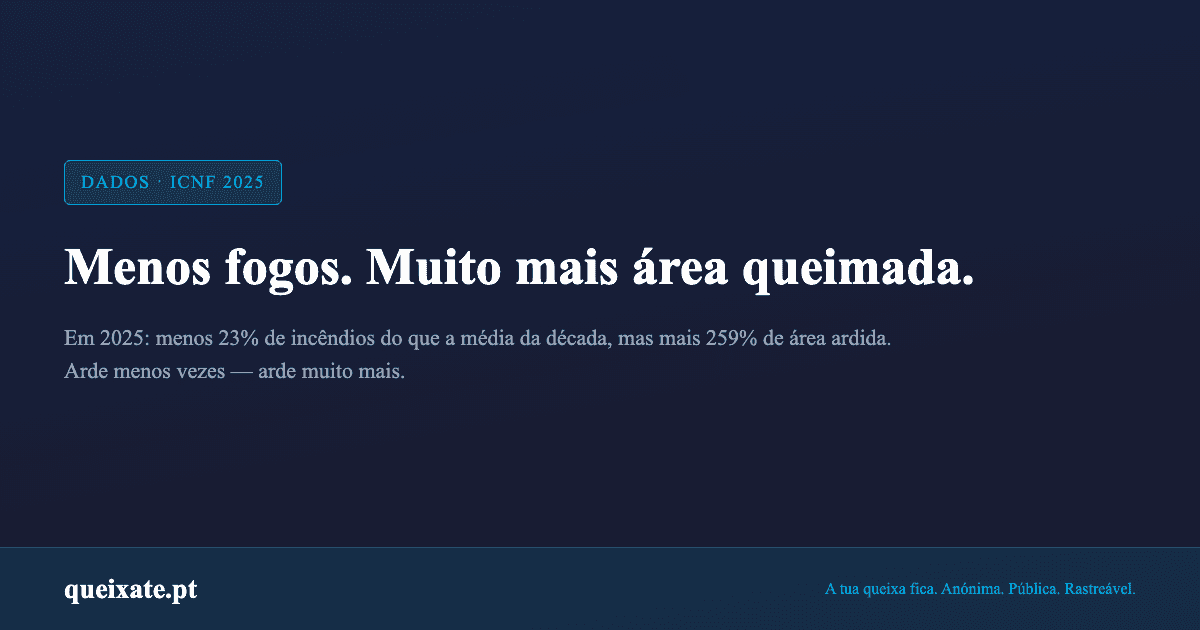
- The most alarming figure: there were 23% fewer fires than the ten-year average, but 259% more burned area — fires start less often, but when they do, they burn far more.
- The legal deadline to clear vegetation and land was 31 May (until 30 June in municipalities under calamity status). The critical fire season begins now.
- The missing piece that connects "the law" to "the land": a place where any citizen can report, with a photo, date and location, uncleaned scrubland near their home — public and traceable. That is what Queixate is for.
A number that should stop the country in its tracks
Fire statistics usually arrive in September, when the smoke has long cleared. But it is worth examining them now, before the heat tightens its grip.
In 2025, according to provisional ICNF reports, 8,235 rural fires were recorded, burning more than 269,000 hectares — including forest stands, scrubland and agricultural land. To put that in perspective, it is an area larger than the entire municipality of Lisbon multiplied many times over.
What makes these figures different is not just their scale. It is the trend. Compared with the average of the previous decade, 2025 saw 23% fewer incidents but 259% more burned area (ICNF, August balance). In other words: fewer fires start, but each fire that escapes grows far larger and burns far more territory.
There are many causes — climate, rural abandonment, land management. But one is within reach of each of us, every year, before the first spark: clearing the land.
The deadline passed on 31 May. What happens next?
Portuguese law is clear about who must clear what, and by when.
Decree-Law no. 82/2021 requires fuel management strips around homes: a 50-metre strip of controlled vegetation in forest areas, and 10 metres in agricultural areas, measured from the outer wall of the dwelling. Around population centres, industrial parks and landfills, the mandatory strip rises to 100 metres.
The deadline to have this work completed in 2026 passed on 31 May (Dispatch no. 3440/2026, from the Secretary of State for Civil Protection), extending to 30 June only in municipalities declared under calamity status.
In other words: by the time you read this, the legal obligation to clear land has already passed. Those who did not comply face a fine. And when the landowner does not clear, responsibility passes to the municipal council, which must carry out the clearing and then charge the cost to the landowner.
On paper, the system is closed. On the ground, we all know it is not.
The law exists. What is missing is the record.
The problem is not a lack of rules. It is the lack of actionable information about where the rules are not being followed.
Local authorities acknowledge this themselves. In early June, municipalities publicly called for reinforcement of the property register, more forestry rangers and a pool of companies to carry out clearances (news item from 1 June 2026). Translation: many councils do not know exactly who owns each piece of land, nor do they have the capacity to inspect everything. Enforcement depends, in large part, on someone raising the alarm.
And this is where the citizen is left without tools. If you see scrubland pressed up against your neighbour's house, an abandoned plot behind the local school, or an uncleared slope at the entrance to your village, what can you do today?
- Send an email to the council (
geral@) — which often neither replies nor provides a case number. - Comment on the council's Facebook page — where the alert is lost in the feed and may be deleted.
- Call a helpline — which does not always answer, and when it does, rarely registers the report.
In all these cases, the alert dies the moment it is made. It is not public, not countable, not traceable. And without a record, no one can cross-reference "where the law requires clearing" with "where clearing has not happened" — exactly the information the council lacked and the citizen had to give.

What the citizen can do today
Territorial enforcement cannot rely solely on drones, rangers and the property register. The person who walks past an uncleared plot every day is the best sensor the country has — as long as they have somewhere to record what they see.
That is the piece Queixate adds:
- Anonymous and without registration. No account is needed, and you do not need to show your face to report an uncleared plot near home.
- With proof. Every report includes a photo, date and location — turning a complaint into a verifiable record.
- Public and traceable. The complaint does not disappear. It remains visible, countable and searchable — for the citizen, for the press and for the council itself.
- Free. For those making the complaint, there is no cost. The cost of not making it can be high.
Clearing a 50-metre strip does not prevent every fire. But a country in which every at-risk plot is flagged, with a date and photo, in a public record, is a country that enters the critical season with its eyes open — rather than discovering the problem only when it sees the smoke.
Fire season has already begun. The clearing deadline has passed. The part that depends on us is still missing.
See an uncleared plot near home? Submit your complaint, anonymous and with a photo, at queixate.pt.
Sources: Institute for Nature Conservation and Forests (ICNF), provisional rural fire reports 2025; Decree-Law no. 82/2021; Dispatch no. 3440/2026 (Secretary of State for Civil Protection); municipal statements on land registration and clearance, June 2026.
Ready to make a difference?
By default, every complaint filed is public. Join thousands of citizens already using Queixate to improve their cities.