671 monitored bathing waters. And the rubbish on the sand on a Sunday afternoon — who records it?
TL;DR
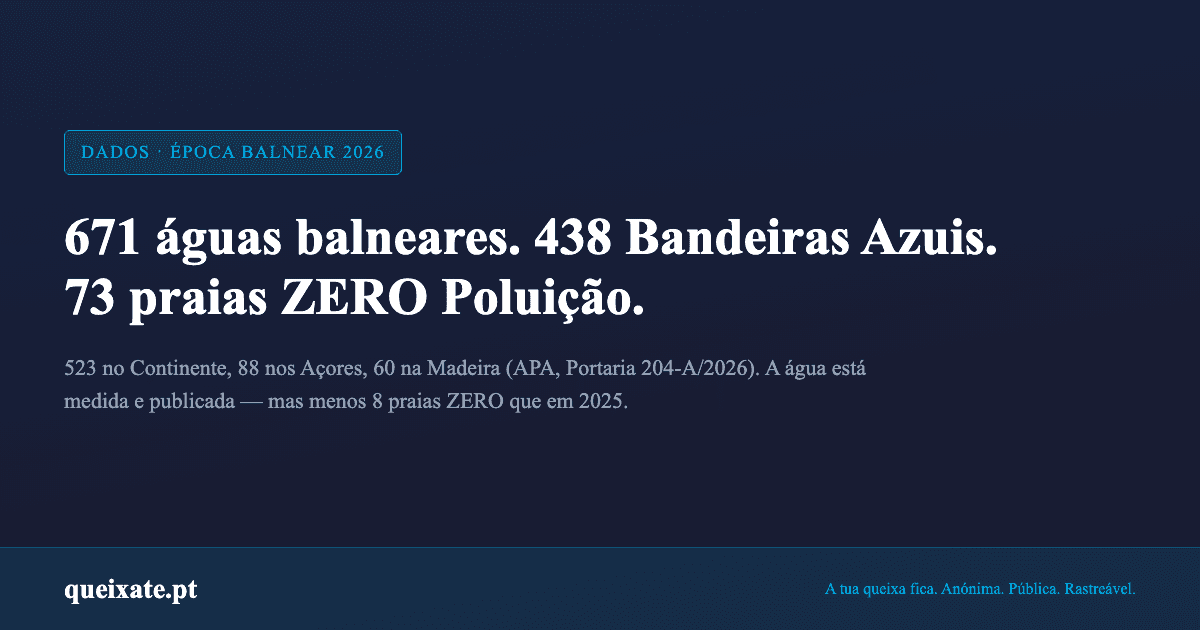
- Portugal entered the 2026 bathing season with 671 classified bathing waters (523 on the Mainland, 88 in the Azores, 60 in Madeira), under Portaria n.º 204-A/2026/1.
- Quality is, overall, excellent: 438 sites received a Blue Flag and 73 beaches hold the "ZERO Pollution" status (water always excellent in the last three seasons) — though that is 8 fewer than in 2025.
- But there is a distinction that changes everything: the official system measures water quality, through periodic sampling. It does not measure, in real time, the state of the beach — the rubbish on the sand, overflowing bins, a broken walkway, the absence of a lifeguard mid-week.
- Between one analysis and the next, weeks can pass. In that interval, the best sensor the country has is whoever is at the beach. What is missing is somewhere to record what they see — publicly, anonymously and traceably. That is what Queixate exists for.
A system that measures well — the water
There is good news for those heading to the beach this summer, and it is worth sharing.
For the 2026 bathing season, the Portuguese Environment Agency identified and classified 671 bathing waters across the national territory — 523 on the Mainland, 88 in the Azores and 60 in Madeira — under Portaria n.º 204-A/2026/1, published in the Official Gazette. Each has defined operating seasons and is monitored throughout the summer.
The overall quality picture is good. In 2026, Portugal counts 438 sites awarded a Blue Flag, the international recognition granted by the Foundation for Environmental Education and coordinated in Portugal by ABAE. And 73 beaches received the most demanding status of all — "ZERO Pollution Beach", awarded by the environmental association ZERO to beaches where, in the last three bathing seasons (2023–2025), no analysis detected microbiological contamination: always classified as "excellent", with no Escherichia coli or enterococci above the limit.
There is also a place to consult all of this. Through SNIRH and the InfoÁgua service from APA, anyone can view the analysis results for the current season, beach by beach.
In other words: when it comes to water quality, Portugal has a serious, transparent and accessible system. That is not the gap.
What the system does not measure
The detail that tends to be overlooked is this: the bathing classification measures the water, and it measures it by sampling. Analyses are carried out at defined points and dates throughout the season — not continuously, not in real time.
This leaves two things out.
The first is everything that is not the composition of the water: rubbish piled up on the sand at the end of a packed Sunday at the beach, overflowing bins at the entrance, a broken shower, a broken access walkway that prevents a wheelchair from reaching the sand, the absence of a lifeguard mid-week, the chaotic parking that blocks emergency access. None of this appears in a microbiological analysis — and none of it shows up in the flag flying at the post.
The second is the time between samples. A single discharge, runoff after a summer thunderstorm, an algal bloom, an episode of dead fish on the surface — when these happen the day after collection, they may take time to be picked up by the system. The flag can stay green for days while the beach, at that moment, is not in good shape. And the award's own numbers are a reminder that quality fluctuates: in 2026 there are 8 fewer ZERO Pollution beaches than in 2025, with 31 beaches losing the status and 23 gaining it.
None of this is a failure of the official system. It is the limit of any system based on laboratory sampling. What is missing is not more laboratories. It is a real-time sensor — and that sensor is the people who are at the beach at that moment.
And there is the whole beach that nobody classifies
There is also a third blind spot. The 671 bathing waters are the classified ones — they are not every place where Portuguese people actually swim.
Many river beaches, reservoirs, lagoons and small stretches of sand used by local communities fall outside the list, without surveillance and without regular monitoring. These are precisely the places where a problem — an upstream discharge, rubbish left after a busy weekend, the lack of any safety infrastructure — can go unnoticed for an entire season, because nobody is officially measuring it.
In these places, the citizen is the only source of information that exists. And, today, they have nowhere to record it in a useful way.
What citizens can do today
Whoever sees the problem at the beach currently has the usual tools — and they all fail for the same reason.
- Sending an email to the council or the Harbour Master — which often does not reply or return a case number.
- Commenting on the council's or operator's Facebook page — where the warning gets lost in the feed and may be deleted.
- Calling a helpline — which does not always answer and rarely records what is said.
In all cases, the alert dies the moment it is made. It is not public, not countable, not traceable. And without a record, nobody can cross-reference "where the beach is classified as good" with "where, on that day, it was not".
That is the piece that Queixate adds to the system:
- Anonymous and without registration. No account or name is needed to flag a beach with rubbish, no lifeguard or degraded access.
- With evidence. Every complaint includes a photo, date and location — which transforms a frustrated remark into a verifiable record.
- Public and traceable. The complaint does not disappear. It remains visible, countable and searchable — for the citizen, for the press and for the council itself.
- Free. For whoever makes the complaint, it costs nothing.
The Blue Flag says the water was excellent at the last sampling. It says little about the overflowing bin next to you this Sunday. Both things matter — and only one of them has someone to record it today.
This summer, water quality is measured and published. The rest of the beach depends on who is there.
Do you see rubbish on the sand, no lifeguard, or degraded access at a beach near you? Record your complaint, anonymous and with a photo, at queixate.pt.
Sources
- Agência Portuguesa do Ambiente (APA) — 2026 bathing season and classified bathing waters (671 bathing waters; Portaria n.º 204-A/2026/1, Diário da República, 30-04-2026). apambiente.pt · SNIRH / InfoÁgua
- ABAE — Associação Bandeira Azul da Europa — 2026 award holders (438 sites). bandeiraazul.abaae.pt
- ZERO — Associação Sistema Terrestre Sustentável — "73 ZERO Pollution Beaches in 34 municipalities, 8 fewer than in 2025" (criterion: water always "excellent" 2023–2025). zero.ong
Ready to make a difference?
By default, every complaint filed is public. Join thousands of citizens already using Queixate to improve their cities.