
Every Portuguese person produces half a tonne of waste per year. What about the bin on your street?
TL;DR
- In 2024, Portugal produced more than 5.2 million tonnes of municipal waste — around 517 kilograms per resident, nearly half a tonne of rubbish per person, according to the Portuguese Environment Agency (APA).
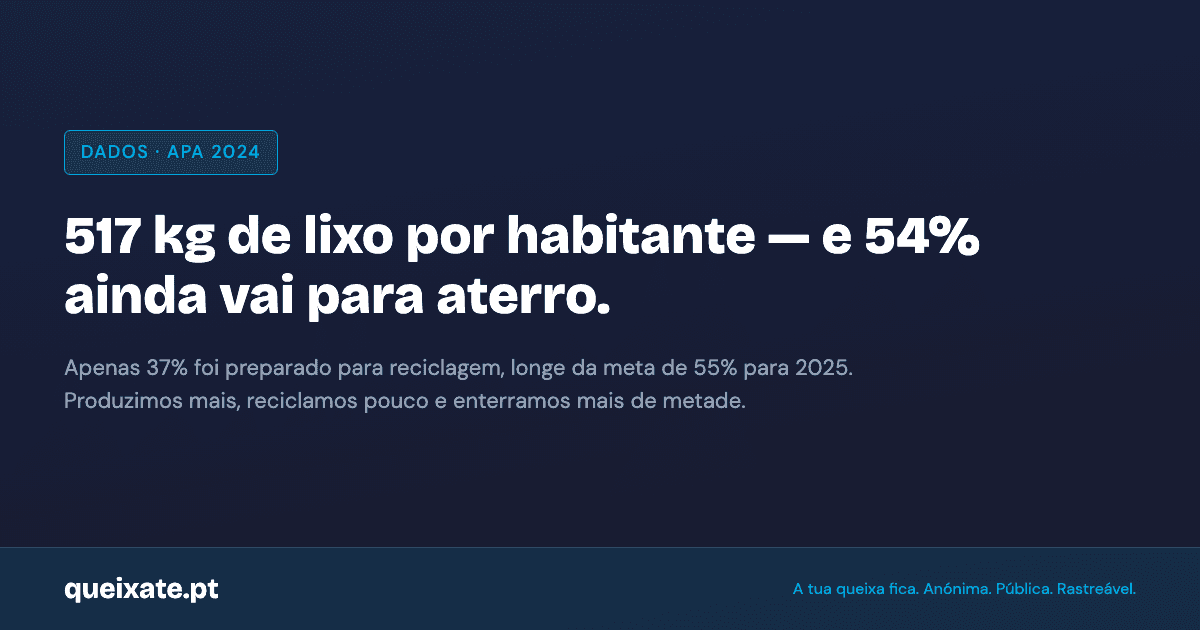
- Of all that waste, 54% still ended up in landfill and only 37% was prepared for reuse and recycling — far short of the 55% target Portugal had committed to reaching by 2025.
- The collection and management of municipal waste is not an optional extra: it is a mandatory public service and, in the vast majority of cases, the responsibility of the local council (or the inter-municipal system it belongs to).
- A bin overflowing for days, missed collections, a recycling point that's been full for a week, bulky items abandoned on the pavement: none of this is «bad luck». It is a service that is not working — and one that has an identifiable party responsible.
- Citizens don't need to know which company was awarded the collection contract to notice a bin spilling onto the street. They need a place to report it. That is what Queixate is for.
Half a tonne of waste per person — and most of it goes to landfill
There is one number that sums up the problem before we enter any discussion about recycling points or waste separation: in 2024, every resident in Portugal produced, on average, 517 kilograms of municipal waste. That is nearly half a tonne of rubbish per person, totalling more than 5.2 million tonnes across the country — and the figure has been rising, not falling.
What happens to that mountain of waste is the uncomfortable part. According to the State of the Environment Report published by the APA, 54% of municipal waste still ended up in landfill in 2024 — buried in the ground. Only 37% was prepared for reuse and recycling. And this at a time when the European target, signed up to by Portugal, was to reach 55% recycling as early as 2025 and reduce landfill disposal to a maximum of 10% by 2035.
In plain terms: we are producing ever more waste, recycling barely more than a third of it, and burying over half. Portugal remains among the European Union countries most dependent on landfill — the cheapest solution in the short term and the most costly for those who will live here afterwards.
Whose rubbish is it on your street? The council's
Here is the part that tends to be missing from conversations about recycling, which always focus on what citizens do — or fail to do — at the recycling point. Upstream of our own sorting habits there is a public service that must exist, function, and be held to account: municipal waste collection. And that service is, by law, the responsibility of local councils.
It is the council — directly, through a municipal company, or via an inter-municipal system it belongs to — that ensures the collection, transport and disposal of household waste, that places and maintains bins and recycling points on public roads, that sets collection routes and frequencies, and that handles bulky items and large waste. All of this service is regulated at national level by ERSAR, the regulatory authority for water and waste services, and is framed by the General Waste Management Regime.
This is not about blaming those who carry out the collections, often in the early hours of the morning and with limited resources. It is a reminder of one simple fact: when the bin on your street has been overflowing for three days, someone has an obligation to fix it — and should know they are failing.
In summer, the problem smells worse
There is a time of year when these failures stop being a nuisance and become a public health problem: summer. In the heat, organic waste decomposes quickly, poorly sealed bins attract insects and rodents, and what on a winter's day was «a full bin» becomes, in August, a source of smell and flies right outside your front door.
Add to this the seasonal pressure: in tourist and coastal areas, the population multiplies for weeks and waste generation surges — without collection frequency always keeping pace. The result is familiar: bins spilling onto the pavement, bags piled up beside them, recycling points so full they push people to leave glass and cardboard on the ground. None of this is inevitable. It is a management failure — and management has someone responsible.
What you can notice — and report — on your street
You don't need to understand waste logistics to recognise a service that isn't working. Next time you walk past the bin on your street, three concrete questions:
- Is the bin overflowing repeatedly? A full bin on one day is normal. A bin spilling onto the street several days in a row means collection or installed capacity is not enough — and that can be fixed.
- Is collection actually happening? If waste is building up on days when it should have been collected, if a recycling point has been full for a week, or if nobody has come to collect the bulky items you requested, the service is failing at the basics.
- Is there waste where it shouldn't be? Bags abandoned on a plot of land, rubble on the pavement, an informal «dump» gradually forming on waste ground — all of this is the council's business to resolve, and it often just needs to be reported.
None of these situations gets resolved through a social media complaint that no one acts on. They get resolved through a report directed at whoever has the authority to act — and through the ability to track whether it was dealt with.

From bystanders to people who hold others to account
Individual recycling matters — sorting properly is the minimum each of us can do. But the conversation cannot stop there, as if the waste problem were purely a question of good and bad citizens at the recycling point. Before our own sorting there is a public service that must be up to the task: enough bins, regular collections, recycling points that are not permanently full, responses to bulky items and illegal dumping.
That service is the council's responsibility. And where there is a responsible party, there is the possibility to report, demand accountability, and follow up. Next time you walk past an overflowing bin, you do not have to accept it. You have to report it.
Submit your complaint at queixate.pt — it's free, it's anonymous, and it goes straight to whoever has a duty to respond.
Ready to make a difference?
By default, every complaint filed is public. Join thousands of citizens already using Queixate to improve their cities.