
More than a million Portuguese people live with harmful noise. And most councils don't even have a plan to reduce it.
TL;DR
- More than one million people in Portugal are exposed to environmental noise levels that are harmful to health, the environmentalist association ZERO warned in April 2026. Around 20% of the mainland population — close to two million people — live with enough noise to disrupt their sleep.
- Summer makes everything worse: café terraces open until the early hours, construction works, festivals and holiday traffic. In Lisbon, more than 70% of measurements taken by residents during the summer exceeded legal limits.
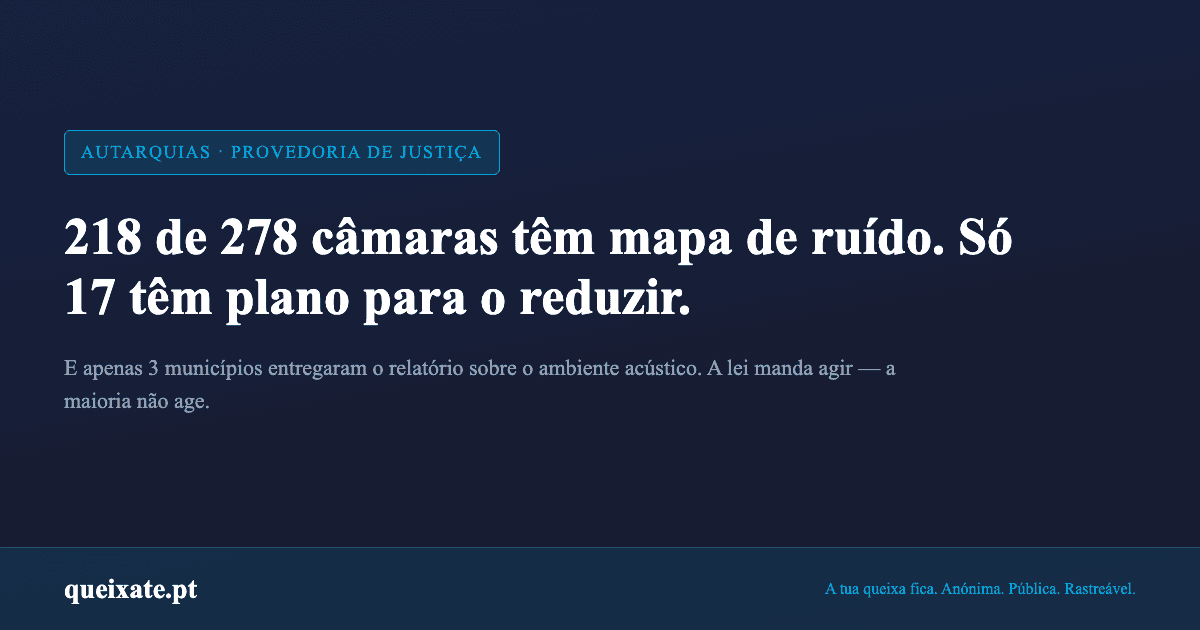
- The law requires councils to act. But, according to the Ombudsman (Provedoria de Justiça), only 218 of the 278 mainland municipalities had approved a noise map by April 2025, only 17 had a municipal noise reduction plan, and only 3 had submitted the acoustic environment report. ZERO estimates that 18% of local authorities have never even produced a noise map.
- Citizens don't see the map. They hear the noise. What's missing is a place — public, anonymous and traceable — to file a complaint, council by council. That's what Queixate is for.
Summer turns up the volume
There is a background sound that changes in July and August. Café terraces fill up and stretch into the night. Construction works left for summer begin. Festivals, street fairs and open-air concerts arrive. Holiday traffic shifts its patterns, and with it the noise of engines and horns. For those away on holiday, it's scenery. For those who stay behind, it's one bad night's sleep after another.
This isn't just a feeling. Between 28 July and 30 September, Lisbon residents organised under the RuídoLX project measured noise levels on their streets: in more than 70% of measurements, the values exceeded legal limits. Summer noise is real, it is measurable — and, in most cases, it is illegal.
It's not an inconvenience. It's a public health issue.
For a long time we treated noise as a matter of common sense between neighbours. Science no longer sees it that way.
In April 2026, on International Noise Awareness Day, ZERO sounded the alarm again: more than one million people in Portugal remain exposed to environmental noise levels harmful to health. The main source is road transport, followed by air traffic.
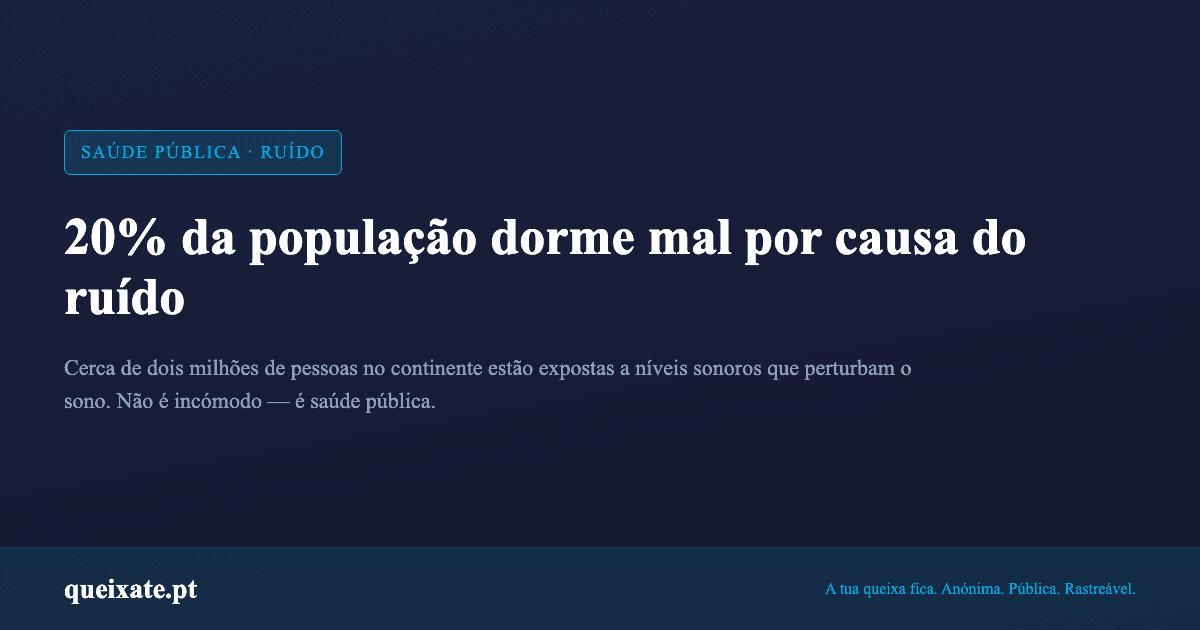
The number of people affected is larger than commonly thought. It is estimated that around 20% of mainland residents — close to two million people — are exposed to noise levels that cause sleep disturbances, and that 15% (around 1.5 million) suffer from at least moderate annoyance. Prolonged exposure to noise goes beyond bad moods: it is associated with sleep disorders, stress, high blood pressure and cardiovascular disease.
The law requires councils to act — and most don't
Here is the point that tends to get lost in the conversation: noise is not a problem without an owner. The General Noise Regime assigns very concrete responsibilities to municipalities. Each council must draw up and keep updated the noise map for its territory, approve a municipal noise reduction plan wherever limits are exceeded, and enforce controls on noisy activities — from construction works to entertainment venues. This is not a suggestion. It is a legal obligation.
The problem is compliance. In a report dedicated to the subject — Noise Control: planning, managing and raising awareness — the Ombudsman painted an uncomfortable picture. As of April 2025:
- 218 of the 278 mainland municipalities had approved a noise map — leaving around 60 councils without the basic instrument to know where the problem exists;
- only 17 municipalities had adopted a municipal noise reduction plan;
- and only 3 municipalities had submitted their municipal acoustic environment report.
ZERO's reading is even harsher: 18% of local authorities have never produced a noise map, most existing maps are out of date, and only 11 municipalities have active reduction plans in force — many of those also overdue for review.
In plain terms: most municipalities know, at best, where noise exists — but have no approved plan to bring it down. And without a plan, the map sits gathering dust in a drawer.
What your council should have — and what you can demand
You don't need to be a lawyer to know what to ask your council. Three concrete things:
- Is the noise map complete and up to date? It is the portrait of the territory. Without it, the council does not know (nor can it prove it knows) where the critical hotspots are.
- Is there a municipal noise reduction plan for areas where limits are being exceeded? This is the document that turns diagnosis into action — traffic interventions, road surfaces, speed limits, conditions for construction works and outdoor terraces.
- How is neighbourhood noise and noisy activities enforced? Out-of-hours construction, terraces operating beyond their licence, equipment noise: is there a channel for complaints, and does it get a response?
These questions are not adversarial. They are exactly the kind of scrutiny that makes a council work better. A local authority that has a map, a plan and a complaints channel that responds is one that is easier to defend — not harder.
From annoyance to record
The obstacle, more often than not, is not the lack of grounds for complaint. It is the lack of a place to file one. A burst water pipe leaves a mark in the street; noise disappears into the air as soon as the night ends. What remains is the memory of yet another bad night's sleep — and no public record that it ever happened.
That is the gap Queixate fills. Anyone can file a complaint about noise — or about any other problem on their street — anonymously, free of charge and without creating an account. The complaint is linked to the correct municipality and becomes public and traceable: it stops being an isolated grievance and becomes a signal, council by council.
Every complaint filed is a dot on the map the local authority may not yet have drawn. And when many voices point to the same street, at the same time, it becomes much harder to claim the problem does not exist.
This summer, if noise is keeping you awake, don't let your complaint dissolve with the silence of the next morning. File it.
👉 Submit your complaint at queixate.pt — anonymous, free and no account needed.
Ready to make a difference?
By default, every complaint filed is public. Join thousands of citizens already using Queixate to improve their cities.