
Over 600,000 Portuguese people struggle to walk. Was your street designed with them in mind?
TL;DR
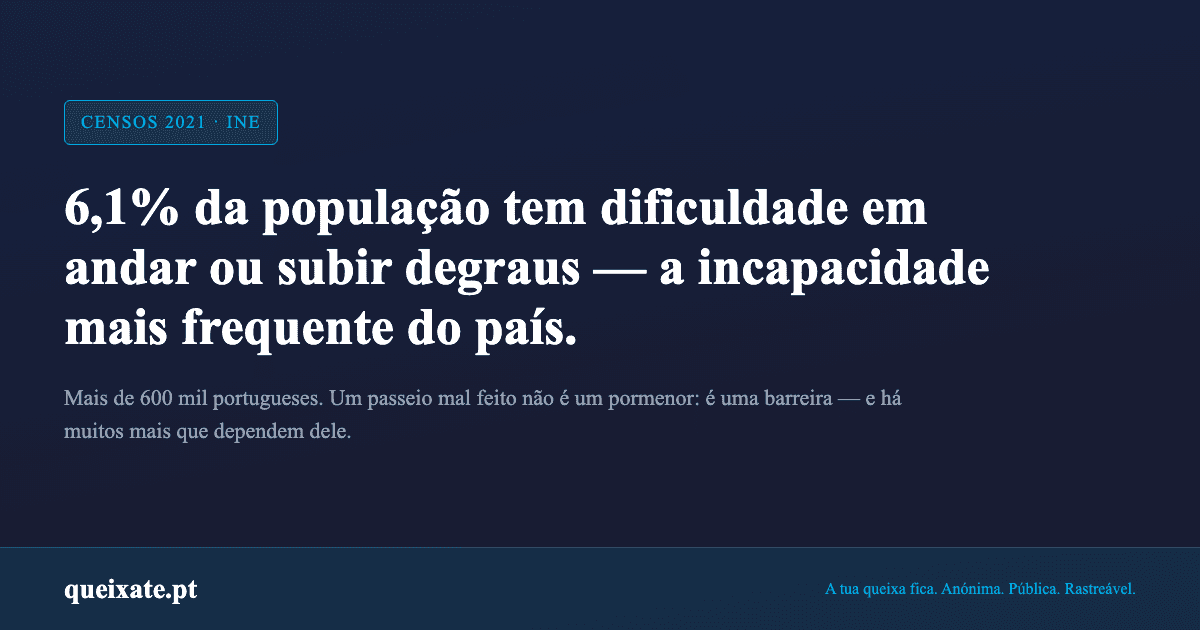
- According to the 2021 Census (INE), 10.9% of the population has at least one disability. Difficulty walking or climbing stairs is the most common of all and affects 6.1% of people — more than 600,000 Portuguese citizens. These are not rare cases: they are people who live on your street.
- A narrow pavement, a kerb without a dropped ramp, a café terrace blocking the way or a car parked on a pedestrian crossing are not minor details. For someone in a wheelchair, pushing a pram, or unable to climb a high step, they are a wall.
- The accessibility of public space is not a favour — it is the law. Decree-Law 163/2006 requires pavements, streets and buildings to be accessible, and the deadlines for adapting existing infrastructure expired nearly a decade ago.
- Enforcing and complying with this law in public space is the council's responsibility. Non-compliance is a regulatory offence, with fines ranging from €250 to over €3,700 for individuals.
- Citizens do not need to know the number of the decree to notice an impassable pavement. They need somewhere to report it. That is what Queixate is for.
The city has steps that do not appear on any map
There is a city that most of us never see, because we pass through it without effort. It is the city of those who must plan every route: where there is a pavement, where it disappears, whether a given kerb has a dropped ramp or a fifteen-centimetre drop, whether the terrace of a particular café leaves room for a wheelchair to pass or forces a detour into the road, among the cars.
That city is not a distant minority. The 2021 Census from INE shows that 10.9% of the population has at least one disability, and that difficulty walking or climbing stairs is the most common of all, affecting 6.1% of people — the equivalent of more than 600,000 Portuguese citizens. It is the disability that most penalises working life: it reduces the likelihood of a person being employed by almost 27 percentage points. And it disproportionately affects older women, in their 70s.
Add to these figures all those who, without any permanent disability, still depend on a decent pavement: parents with prams, elderly people with a walking frame, people with a leg in plaster, anyone dragging a shopping trolley. The number of people excluded by a poorly built pavement is far greater than it appears.
In summer, the pavement shrinks
There is one time of year when these barriers multiply: summer. Café terraces take over pavements that were already narrow. Roadworks leave hoardings and uneven surfaces with no signposted alternative. And cars parked on the pavement — those tolerated "just for five minutes" — turn a manageable route into a dead end for anyone in a wheelchair who cannot simply walk around through the road.
None of these things are inherently illegal. A café terrace brings life to the city; roadworks are necessary. The problem is when they are set up as though no one in a wheelchair would ever pass by — without a minimum clear width, without a ramp, without a passable corridor. Accessibility is not opposed to terraces or roadworks. It is opposed to the carelessness with which they are so often installed.
This is not goodwill. It is the law — with deadlines that have already passed
Here is the part that tends to be missing from the conversation: making public space accessible is not a matter of goodwill on the part of councils. It is a legal obligation.
Decree-Law No. 163/2006, in force for nearly 20 years and revised in 2014, 2017 and 2019, defines the technical accessibility standards that pavements, public roads, public spaces and buildings must meet — minimum widths, ramps, dropped kerbs at pedestrian crossings, level surfaces. And, more importantly, it set deadlines for adapting existing infrastructure: up to 10 years for older buildings. In other words, the deadlines for bringing public space into compliance have already expired, in most cases, by nearly a decade.
This is not a goal for the future. It is a law that should already have been fulfilled — and that, street by street, often has not been.

Who is responsible for the pavement on your street?
The answer, in the vast majority of cases, is: the local council. It is the council that designs, builds and maintains pavements and public spaces, that licences café terraces, that enforces illegal parking and that has a duty to uphold accessibility standards across its territory. Non-compliance with Decree-Law 163/2006 is a regulatory offence, punishable by fines of €250 to €3,740 for individuals — and considerably more for legal entities.
This is not about blaming those who work in councils, often with limited resources. It is about remembering one simple thing: there is an identifiable person responsible for every impassable pavement. And where there is a responsible party, there is the possibility of reporting, of demanding accountability and of following up.
What you can notice — and report — on your street
You do not need to be an engineer to spot a barrier. Next time you go outside, ask yourself three concrete questions:
- Can you walk the length of the pavement from end to end without stepping into the road? If a wheelchair or pram cannot get through — because of width, a pole in the middle, a café terrace or a badly parked car — the pavement is failing.
- Do the pedestrian crossings have dropped kerbs on both sides? A crossing that ends in a high step is a crossing that excludes anyone who cannot climb steps.
- Do roadworks and café terraces leave a clear, signposted corridor? Or do they push pedestrians — all pedestrians — into the middle of the traffic?
What is not reported is not counted. And what is not counted is easy to leave for next summer.
Report the barrier on your street
An impassable pavement rarely makes the news. It just sits there, year after year, because those who stumble over it every day have nowhere to take the complaint — and those who have never needed it do not even notice it. It is precisely that silence that turns a problem with a known solution into a permanent problem.
On Queixate you can file a complaint about a pavement in poor condition, a pedestrian crossing without a ramp, a café terrace blocking passage or parking that obstructs people with reduced mobility. It is free, anonymous and directed to the right council. One complaint is an isolated case. Many complaints, in the same city, are a map — the map of the barriers that a street accessible to everyone can, and should, tear down.
Ready to make a difference?
By default, every complaint filed is public. Join thousands of citizens already using Queixate to improve their cities.