Portugal created the world's first national participatory budget. But civic participation shouldn't happen just once a year.
TL;DR
- In 2017, Portugal became the first country in the world to launch a participatory budget at national scale. Add to that an older movement: dozens of Portuguese municipalities already had — and still maintain — their own participatory budgets.
- The participatory budget is a sound democratic idea: citizens propose and vote on projects, and the council commits to delivering the most-voted ones. But it has a structural limitation — it happens once a year, with a fixed pot of money and in a competition between proposals.
- Day-to-day problems don't wait for a vote. The overflowing bin, the broken streetlight, the pedestrian crossing that has disappeared — they turn up in any week of the year and don't fit into an annual project cycle.
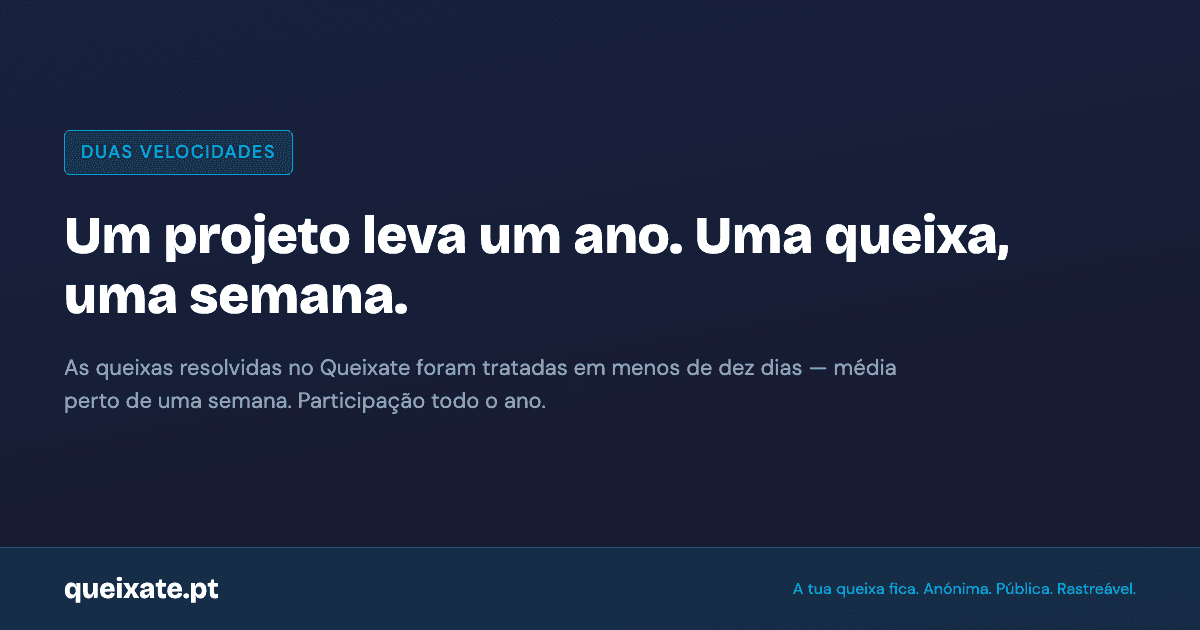
- Data from Queixate itself reveals the other side of participation: concrete complaints resolved in under ten days, with an average close to one week. That's low-friction participation, all year round.
- These are not alternatives — they are two cogs in the same engine. Vote in your area's participatory budget when it opens; log public-space problems whenever they arise.
A Portuguese idea that went around the world
There are civic achievements Portugal rarely talks about. This is one of them: in 2017, the country launched the Orçamento Participativo Portugal, becoming the first in the world to take participatory budgeting to national scale. For the first time, any citizen could propose a nationwide project and vote on it — and the most-voted proposals would be delivered with public money.
But the seed had been planted long before, above all at the local level. Over the past two decades, dozens of Portuguese municipalities adopted their own participatory budgets: councils that ring-fence a share of their annual budget for projects chosen directly by the people who live there. A garden, a playground, a walking trail, the regeneration of a square — ideas born from those who know the neighbourhood, decided by vote, not behind closed doors.
The logic is powerful and simple: those who pay for and use public space should have a say in what is done with it. It is civic participation in its most visible form — and Portugal, on this front, was ahead of the curve.
What the participatory budget does well — and what it cannot do
It is worth being fair to the instrument before pointing out its limits. The participatory budget does three things very well: it gives citizens real decision-making power over a portion of public money; it makes visible where that money goes; and it builds the habit of participation — of looking at your town and thinking, «what could be better here?»
But, by its very nature, the participatory budget has three structural limits:
- It happens once a year. There is a window to propose, a window to vote, and then a year of delivery. Outside that window, the channel closes.
- It has a fixed pot of money. A pre-defined amount is distributed among a handful of winning projects. What doesn't win the vote gets left behind — even if it is needed.
- It is a project competition, not a maintenance service. It exists to build new things — a park, a trail, a facility. It was not designed to repair what already exists and breaks down day to day.
And this is where a huge part of shared life falls through the cracks. Because most failures in public space are not projects waiting to be built — they are maintenance problems that arise at any moment: the pothole that opened this week, the lighting that went out yesterday, the rubbish that has been piling up for ten days. None of these fit into an annual voting cycle. Waiting for the next participatory budget to fix a broken bin would be absurd — and no one does it.
What the data shows: participation that works every day
If the participatory budget represents large-scale, low-frequency participation — once a year, large projects — the other half is missing: small-scale, high-frequency participation, logging a concrete problem when it happens.
And Queixate data shows that this other half works. We looked at complaints that have already been resolved through the platform — cases where the council registered the situation as dealt with — and the picture is clear: they were closed within roughly 3.5 to ten days, with an average close to one week. The most concrete issues, such as a piece of road infrastructure, appear among the fastest, resolved in around three to four days.
Honesty about scale is important: Queixate is just getting started, and we are still talking about a limited number of cases spread across several municipalities. This is not a national survey, and we do not present it as one. But the contrast with the annual rhythm of the participatory budget is telling: while a voted project takes a year or more to get off the ground, a well-logged maintenance problem can be resolved in the same week. Two different speeds — for two different kinds of participation.
Two cogs in the same engine
The mistake would be to set the two things against each other. They are not opposites. The participatory budget and day-to-day complaint logging are two cogs in the same civic engine — the engine of those who refuse to look at their community with indifference.
One is for deciding what gets built: where the next park should go, the next walking trail, the next regeneration project. The other is for keeping what already exists running: making sure the pedestrian crossing is visible, the streetlight comes on, the bin gets emptied. We need both — and we can use both, without having to choose.
In practice, this translates into a simple civic habit within anyone's reach:
- Find out when your council's participatory budget opens. Most municipalities that have one publish the dates on their website. When it opens, propose and vote — it's your share in deciding what gets built.
- Don't save problems for that window. A pothole, a missing sign, a pile of rubbish — that's not material for the next project cycle. It's a report to be made today, directed to the right council, with a date and a location.
- Follow up on both. The project you voted for and the complaint you logged both deserve follow-through. Participation doesn't end with the vote or the submission — it continues until the thing is done.
It is precisely for that second cog that Queixate exists: turning a public-space problem into a report directed to the right council, with a date and the ability to track progress — anonymously, publicly, and traceably. It doesn't replace the participatory budget. It completes it, in the other three hundred and some days of the year when there is also participation to be done.
Participation is a habit, not an event
Portugal showed the world that participation at national scale was possible. The next step is quieter, but equally important: making participation a year-round habit, not an annual event. Voting when the participatory budget opens. And, in the meantime, not letting the problem on your street go unrecorded — logging it, directing it to the council, and following it through to the end.
Next time you walk past that pothole, that broken streetlight, or that overflowing bin, don't wait for the next vote. Log it at queixate.pt. Your complaint stays — anonymous, public, and traceable.
Ready to make a difference?
By default, every complaint filed is public. Join thousands of citizens already using Queixate to improve their cities.