
Portugal has around 3 million street lights. And the broken lamp post on your street — how long has it been dark?
TL;DR
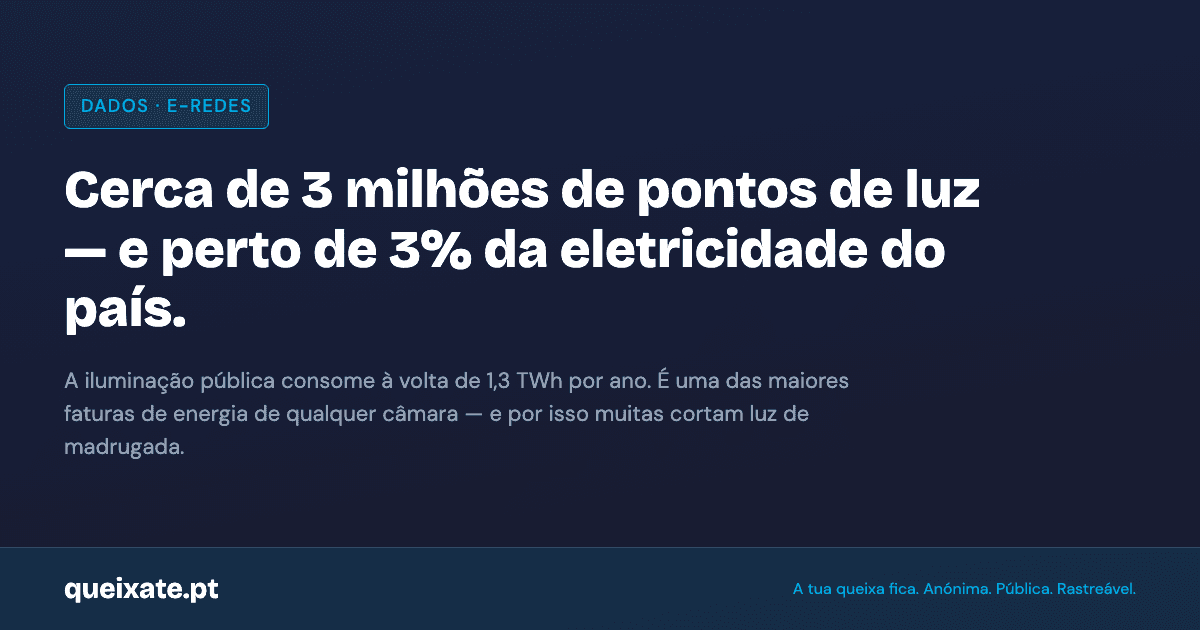
- Mainland Portugal has around 3 million public lighting points, consuming roughly 1.3 TWh of electricity per year — close to 3% of all electricity distributed on the grid, according to data from the distributor E-Redes (formerly EDP Distribuição).
- Installing, maintaining, repairing and setting public lighting schedules is, by law, the municipality's responsibility. The broken lamp post on your street is not the electricity company's problem — it is the council's.
- A dark street is not just an inconvenience: the World Bank classifies public lighting as a factor of safety, inclusion and sustainability. It is more serious for those who walk alone at night — particularly women, the elderly and children.
- Many councils dim or switch off part of their lighting in the early hours to save money (the public lighting bill is one of the largest expenses for any local authority). Saving is legitimate — but the decision about which streets are left in the dark should involve the people who live there.
- A burnt-out lamp post can stay broken for months because nobody reported it to whoever is responsible for fixing it. Citizens do not need to know the lamp post number — they need somewhere to log it. That is what Queixate is for.
Three million street lights — and a bill that weighs on councils
Before we talk about the lamp post on your street, a number to put things in perspective: mainland Portugal has around 3 million public lighting points. Together they consume roughly 1.3 TWh of electricity per year, the equivalent of close to 3% of all electricity distributed on the national grid — figures released by the distributor E-Redes, formerly EDP Distribuição.
This has a practical consequence that rarely makes it out of the economics pages: public lighting is, for many councils, one of the largest items on the electricity bill — in some cases the largest of all. It is no surprise that modernisation has become a priority: switching to LED technology delivers savings of over 70% in consumption, and combining LED with smart management systems can achieve reductions of around 80%. Several municipalities have already signed multi-year energy efficiency contracts for precisely this reason.
All well and good so far. The problem starts when the savings calculation is made by switching lights off — without factoring in the people who live there.
Who owns the lamp post on your street? The council
Here is the part that usually gets left out of the conversation. When a lamp post blows, many people do not know who to complain to — and assume it is «the electricity company's» problem. It is not. Managing public lighting is the municipality's responsibility: it is the council that decides where there is light, what type of fitting is installed, what time it switches on and off, and it is the council that must ensure maintenance and repairs when a lighting point fails.
The distributor operates the electricity network, but the body that defines, pays for and orders repairs to public lighting is the local authority — directly or through a management contract. That is why, from one municipality to the next, the same fault can be fixed in days… or drag on for months. It is not a lack of electricity: it is a maintenance service that, on that particular street, is not working.
And this matters because a blown lamp post does not «flag itself» in the system. It is often only repaired after someone reports it. A lamp post in the middle of a busy street is quickly flagged; one on a side alley or a little-used pedestrian path can stay dark for weeks without anyone formally logging it.
A dark street is not just inconvenience — it is a safety issue
It is worth spelling out what is actually at stake. A dark street is not merely an aesthetic nuisance. The World Bank classifies public lighting as a factor of safety, inclusion and sustainability — and for good reason. The absence of light increases the perception of insecurity and drives people away from public space at precisely the times and places where they are most vulnerable.
Who feels it first? Those who walk alone at night: women who avoid a poorly lit street on the way home, elderly people who risk a fall on an uneven pavement they cannot see, children leaving an after-school activity at the end of the day. An unlit pedestrian crossing, a dark underpass, a bus stop plunged into darkness — these are spots where the absence of lighting stops being a detail and becomes a hazard.
That is why the increasingly common decision to dim or switch off lighting in the early hours to save money is not a neutral one. Saving public money is legitimate and desirable. But which streets are left dark, at what time and by what criteria is a decision that affects the safety of real people — and those people ought to be able to say something when the blackout leaves them crossing a dangerous spot in the dark.
What you can report — and log — on your street
You do not need to understand lighting engineering to notice when something is not working. Next time you walk down your street after dark, three concrete questions:
- Has a lamp post been out for days? A blown bulb happens. A lamp post that is dark week after week means the fault has not reached the person who needs to fix it — and it gets fixed with a report.
- Is the whole street in the dark? If a stretch, a pedestrian crossing, a park or a bus stop has lost its light — through a fault or an early-morning cut — it is worth reporting, especially if people walk through it on foot.
- Is the light flickering or malfunctioning? Lighting that flickers, switches on at the wrong time or blinks all night is also a fault — and a waste of energy that the council has every reason to correct.
None of these situations gets resolved by venting on social media where nobody forwards it to the right department. They get resolved with a report directed at whoever has the authority to act — and with the ability to follow up and check whether it was dealt with.

From bystanders to people who hold others to account
The broken lamp post on your street is a good test of the state of public space: it is a concrete service, with a concrete responsible party, that is either working or it is not. Portugal has around three million lighting points — and each one is, at its core, a small promise that people can walk safely at night.
When that promise fails, you do not have to shrug and move on. Reporting a broken lamp post, a dark pedestrian crossing or an entire street without light is not «making trouble»: it is giving the council the information it needs to fulfil its own obligation — and leaving a trail that makes it possible to verify whether it was resolved.
If there is a dark street on your way home, log it at queixate.pt. It is anonymous, it is free and it takes less than two minutes. Your street's lighting has someone responsible for it — it just needs to get the message.
Ready to make a difference?
By default, every complaint filed is public. Join thousands of citizens already using Queixate to improve their cities.