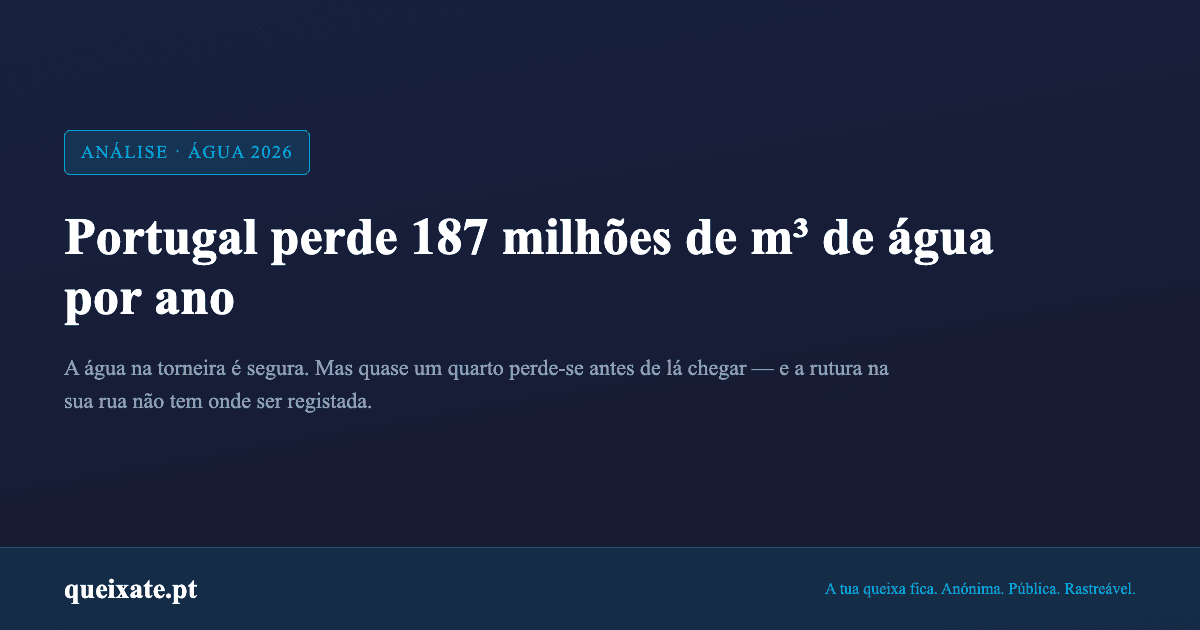
Portugal loses 187 million m³ of water a year. And the burst pipe on your street — who's recording it?
TL;DR
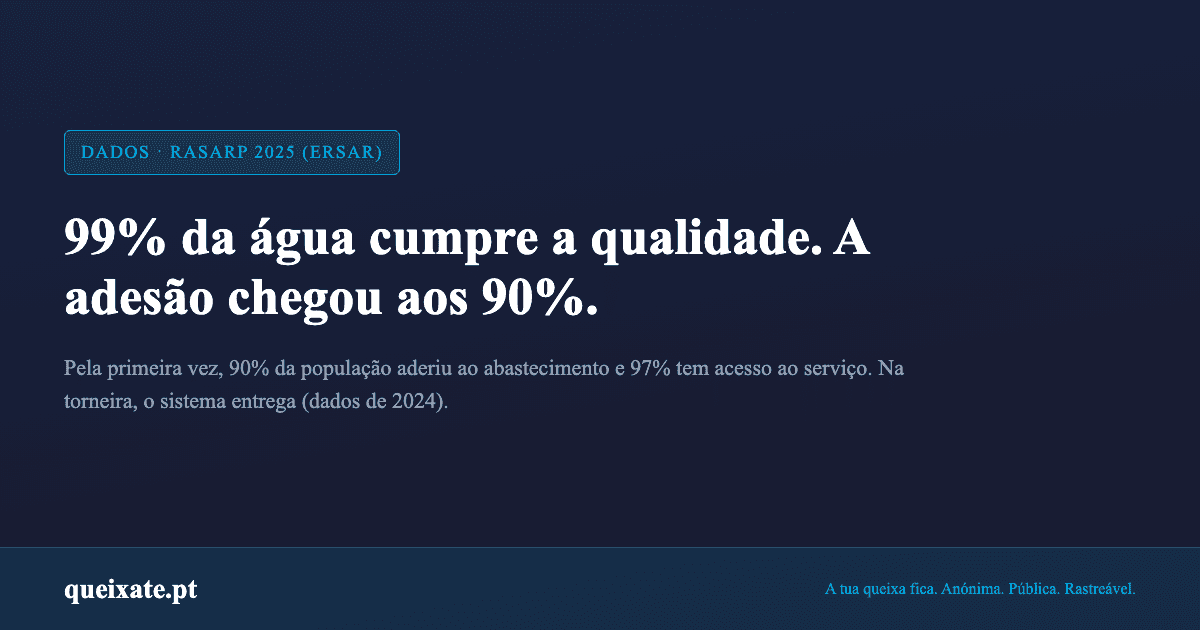
- The water that comes out of the tap in Portugal is safe: 99% of drinking water analyses meet quality parameters, and connection to supply services reached 90% for the first time (ERSAR, RASARP 2025, 2024 data).
- But almost a quarter of treated water is lost before it reaches your home. Real losses amounted to 187.3 million cubic metres in 2024 — the equivalent of 8.7 Olympic swimming pools per hour, every hour of the year.
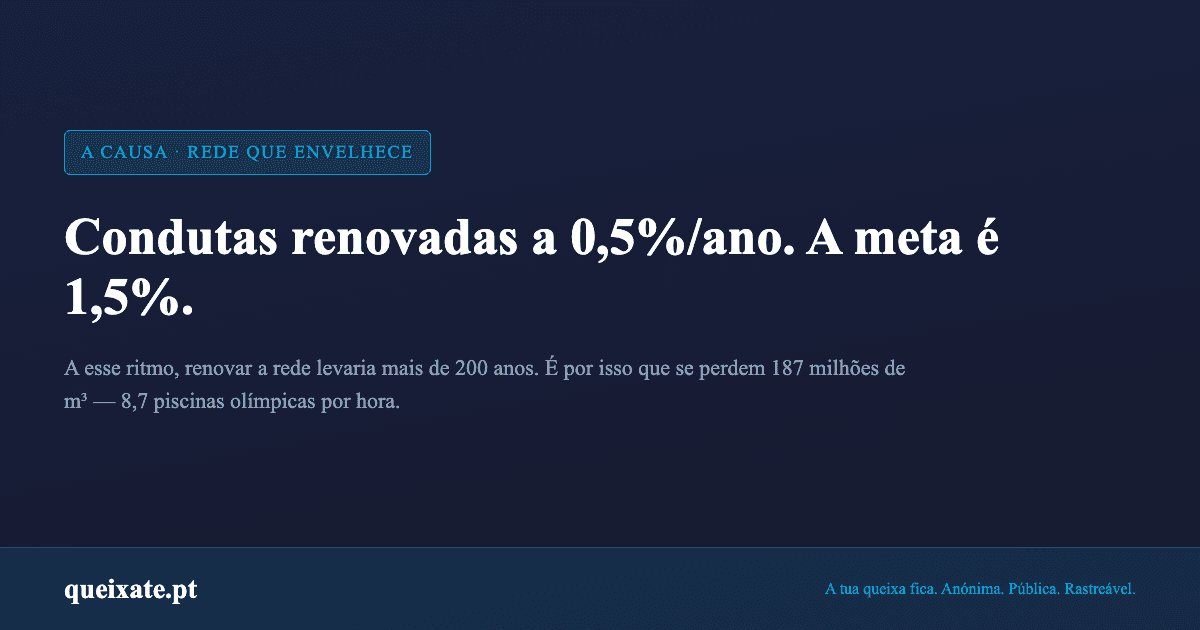
- The root cause is structural: water pipes are being rehabilitated at 0.5% per year, when the target is 1.5%. At that rate, renewing the network would take more than 200 years. Cutting losses by 80% would save around €158 million per year.
- Citizens don't see the statistic. They see the symptom: the burst pipe gushing in the street for days, the pressure that drops, the broken public fountain, the meter nobody reads. What's missing is a place — public, anonymous, and traceable — to record these things, council by council. That's what Queixate is for.
A system that delivers well — on quality
Let's start with the good news, which is real and worth acknowledging.
The water Portuguese people drink is among the most tightly controlled in Europe. According to the Annual Report on Water and Waste Services in Portugal (RASARP 2025) from ERSAR — the sector's regulatory authority —, 99% of drinking water analyses in 2024 met quality parameters. This figure has remained at the top for years.
Coverage has also improved. Connection to the public water supply service reached 90% of the population for the first time, and physical access to the service extends to 97%. In other words: the country knows how to treat water and how to get it to almost everyone.
When it comes to the final product at the tap, the system works. That's not where the leak is.
What gets lost along the way
The detail that tends to escape the headlines is this: between the treatment plant and your tap, a great deal of water disappears.
RASARP 2025 repeats the same structural warning it has been sounding for years: non-revenue water — water that is treated and fed into the network but never billed, because it is lost to leaks, bursts, or unmeasured consumption — stands at around 27% of the total. In volume terms, real water losses reached 187.3 million cubic metres in 2024.
That's a number that's hard to picture, which is why ERSAR itself translates it: it is equivalent to filling 8.7 Olympic swimming pools per hour — not on a peak day, but continuously, hour after hour, all year long. Water that was abstracted, treated, pumped, and paid for with public money, seeping into the ground before it ever serves a purpose.
The cost isn't only environmental. ERSAR estimates that cutting these losses by 80% — combined with reducing the unwanted ingress of water into sewage systems — would save around €158 million per year. That is money from tariffs and municipal budgets literally draining away.
Has there been progress? Marginal. Real losses fell by just 1.3% compared to 2023. At the current rate, the problem isn't being solved — it's being dragged along.
Why water is lost: a network ageing faster than it is renewed
The root of the problem is no mystery, and RASARP measures it with uncomfortable precision.
Water supply pipes in Portugal are being rehabilitated at a rate of 0.5% per year. The recommended technical target is 1.5% — three times faster. For sewage collectors, it is even worse: just 0.1% per year are rehabilitated, and only 2% of collectors more than ten years old were inspected in the last five years.
The maths is simple and devastating: if a network is renewed at 0.5% per year, it takes 200 years to be entirely replaced. No pipe lasts 200 years. The result is infrastructure that ages faster than it is repaired — and every year of delay means more leaks, more bursts, and more water lost.
It isn't a lack of know-how. It is a lack of sustained investment and, often, of political priority: the pipes are buried, out of sight, and don't generate ribbon-cutting moments. A leak only becomes visible when it bursts through the surface — and even then, there isn't always somewhere to report it in a way that leaves a record.
The same pattern in waste
It is worth noting that water is not a unique case. RASARP 2025 reveals the same kind of structural slack in waste management: the recycling rate stood at just 32% in 2024, well short of the EU target of 55% by 2030. Kerbside multi-material collection covers 13% and bio-waste collection just 5%, while 55% of waste still ends up in landfill.
It is the same picture: a service that functions in its essentials, but that drags unmet targets behind it, and whose day-to-day failures — the overflowing recycling bin, the brimming container, the pile of rubble dumped nearby — are again most visible to those who live on the street.
The citizen is the real-time sensor
Here is the point that ties it all together. ERSAR measures the country from above: once a year, through aggregated indicators, council by council. It is essential work — but it is a macro, annual snapshot.
What that snapshot cannot capture is real time and the specific case:
- the burst pipe gushing on the corner for three days, with nobody showing up;
- the pressure that vanishes every morning in a neighbourhood;
- the public fountain broken for months;
- the meter that is never read and the estimated bill that doesn't add up;
- the trench left open and never filled after a repair.
These are precisely the signals that precede and explain the 187 million cubic metres that go missing. And the best sensor the country has to detect them isn't an annual report — it's whoever walks past every day.
The problem is that today that knowledge evaporates like the water itself. The person who spots the leak either doesn't know who to report it to, reports it through a channel that leaves no trace, or gives up because they never find out if anyone on the other side even read it. The complaint stays private, with no public record, no way to verify whether — or when — it was resolved.
What Queixate adds
Queixate is the missing piece between the citizen-sensor and the council: a place where anyone can record what they see — a burst pipe, a leak, a broken fountain, an overflowing bin — in a public, anonymous, and traceable way, tied to the responsible local authority.
It doesn't replace ERSAR or the municipal water services. It complements them: giving real-time visibility to the local symptom that annual indicators only see later, in aggregate. Each registered complaint is a point on the map — and a public record that the problem exists, when it was reported, and whether it was resolved.
The quality of the water from the tap shows that, when there is a system and transparency, Portugal delivers. The losses in the network show what happens when the problem stays buried, with no one to record it. Bringing those failures to the surface — one by one, with a name and a council — is the first step towards fixing them.
Seen a leak, a burst pipe, or a broken fountain on your street? Report it at queixate.pt. It's free, it's anonymous, and it goes on the map.
Sources: ERSAR — Annual Report on Water and Waste Services in Portugal (RASARP 2025), 2024 data, published February 2026.
Ready to make a difference?
By default, every complaint filed is public. Join thousands of citizens already using Queixate to improve their cities.